LUCKETT FARM GUIDE · EXMOOR
Don’t miss: Exmoor Dark Sky Discovery Trail
Best conditions: Clear, moonless skies
2026 festival: 16 October – 1 November
Our advice: Dress warmly and give your eyes time to adjust.
Updated: October 2026
In this guide
Why is Exmoor so good for stargazing?
When is the best time to go stargazing on Exmoor?
Where are the best places to go stargazing on Exmoor?
1. The Dark Sky Discovery Trail
4. Exford and the heart of Exmoor
Can you see the Milky Way from Exmoor?
Stargazing through the seasons
The Exmoor Dark Skies Festival
Can I photograph the stars with my phone?
What should I take stargazing on Exmoor?
Our perfect Exmoor Dark Sky evening
Is Exmoor good for stargazing?
Can you see the Milky Way from Exmoor?
Where is the best place to stargaze on Exmoor?
A Guide to Exmoor’s Dark Skies
Sometimes the best thing to do in North Devon happens after everybody else has gone home.
Wait until the sun disappears, turn away from the towns and look up.
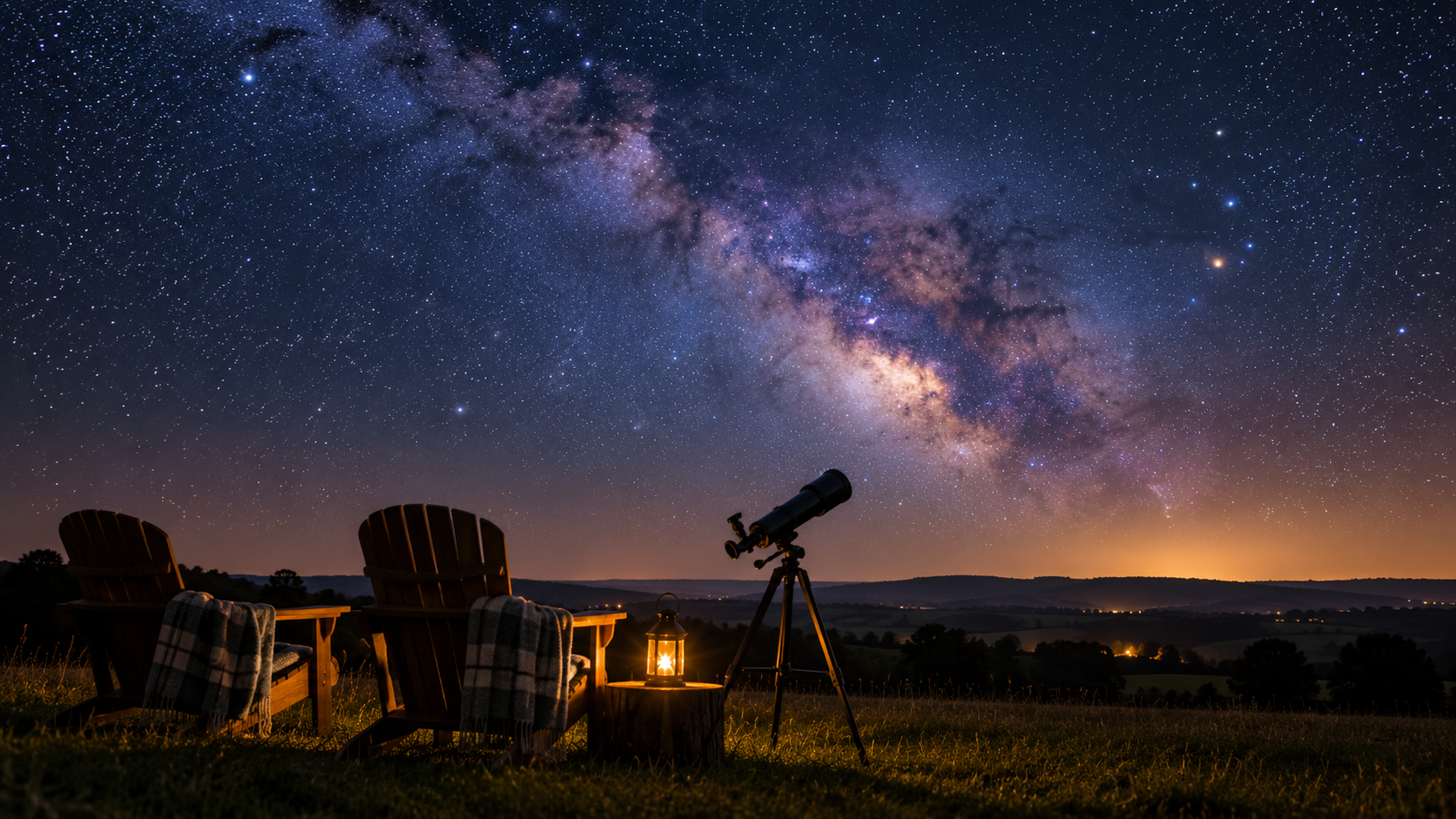
On a clear night, Exmoor's sky can be extraordinary. Thousands of stars become visible, familiar constellations suddenly contain far more detail and, under the right conditions, you may see the Milky Way stretching across the sky.
You don't need a telescope.
You don't need to understand astronomy.
And you certainly don't need to know the names of all the constellations.
Sometimes a warm coat, a clear night and somewhere properly dark are enough.
Welcome to Exmoor after dark.
Why is Exmoor so good for stargazing?
There's a very good reason.
In 2011, Exmoor became Europe's first International Dark Sky Reserve, recognising the exceptional quality of its night skies and the work being done to protect them from light pollution. Exmoor National Park
That darkness makes an enormous difference.
Exmoor National Park says that on a clear night you can see thousands of stars and the Milky Way with the naked eye. Exmoor National Park
If you normally live in or near a town, it's easy to forget how much of the night sky artificial light hides.
Then you come somewhere like Exmoor.
And look up.
Do I need a telescope?
No.
In fact, if you've never really tried stargazing before, we'd suggest starting without one.
Give your eyes time to adjust to the darkness and simply look.
You'll begin noticing more and more.
Stars that weren't immediately obvious appear. Constellations become clearer. Satellites may move across the sky. On the right night you might see a meteor.
And when conditions are good, there's the Milky Way.
Binoculars can be useful too and are considerably easier to carry than a telescope.
If you'd like to take things further, Exmoor National Park Centres also offer telescope hire. Exmoor National Park
Luckett Farm says
For your first night?
Don't overcomplicate it.
Turn the lights off. Put the phones away. Wait 20 minutes. Look up.
That's a pretty good start.
When is the best time to go stargazing on Exmoor?
The ideal combination is:
Clear sky + little or no moonlight + somewhere properly dark.
Exmoor National Park recommends a clear, moonless night if you want to see the greatest number of stars. Exmoor National Park
That doesn't mean you can't stargaze when the moon is visible.
Far from it.
A bright moon can be beautiful in its own right, particularly through binoculars or a telescope.
But if your aim is faint stars, deep-sky objects and the Milky Way, darker is better.
Give your eyes time
This makes more difference than people expect.
Walk out of a brightly lit building, look at the sky and you may initially wonder what all the fuss is about.
Wait.
As your eyes adapt to the darkness, you'll gradually begin seeing more.
Avoid repeatedly looking at a bright phone screen.
If you need a torch, use a red-light setting if you have one.
And be patient.
The sky isn't going anywhere.
Where are the best places to go stargazing on Exmoor?
There are plenty of dark locations across the National Park, but we'd start with places recommended specifically for experiencing Exmoor's night sky.
1. The Dark Sky Discovery Trail
Best for: First-time stargazers · Couples · Families · A proper dark-sky experience
This is probably our first recommendation.
Exmoor has created a dedicated Dark Sky Discovery Trail near Exford, taking you into the core of the Dark Sky Reserve.
The route is approximately 3.2 km / 2 miles, mostly level, and follows a remote moorland track to the ruins of Larkbarrow Farm.
Allow around 1½ hours, including time to stop at the midpoint and look at the sky. Glow-in-the-dark signs help mark the route. Exmoor National Park
And when you reach Larkbarrow, you get something rather special:
360-degree views of the night sky. Exmoor National Park Authority Shop
Luckett Farm says
If you're staying with us and want to make stargazing an actual evening out, rather than simply looking up from outside your accommodation, we'd start here.
Take warm clothes.
Take a torch.
Take something hot to drink.
And don't rush.
Exmoor Dark Sky Discovery Trail
2. Brendon Common
Best for: Serious stargazing · Wide horizons · Milky Way
For something even more open, Brendon Common around Brendon Two Gates sits within the core of the Dark Sky Reserve.
Exmoor's Astronomer's Guide describes the site as having 360-degree unobstructed views and particularly good conditions for deep-sky, lunar and planetary observing, constellations and the summer Milky Way. Exmoor National Park
Luckett Farm says
This is more for people deliberately going out to observe the sky than somewhere we'd casually stop on the way home.
Come prepared.
And remember that Exmoor at night is properly dark.
That's why you're there.
3. Wimbleball Lake
Best for: Open skies · Dark Sky events · Photography
The area around Wimbleball Lake is another established location for Exmoor dark-sky experiences.
Events around Wimbleball feature in the National Park's Dark Skies Festival programme, and the open landscape provides excellent opportunities for experiencing the night sky. Exmoor National Park
Water can add another dimension too, particularly for photographers when stars or moonlight reflect across the surface.
Luckett Farm says
This could make a lovely late-afternoon and evening trip.
Explore this side of Exmoor while it's light, find somewhere for an early dinner and then stay out for the stars.
4. Exford and the heart of Exmoor
Best for: Combining a day on Exmoor with stargazing
Exford makes a good base for exploring some of Exmoor's darkest countryside.
The Dark Sky Discovery Trail is nearby, and the wider area around central Exmoor takes you away from the brighter coastal towns.
Luckett Farm says
Make a day of it.
Exmoor walk → country pub → sunset → stars → back to Luckett Farm.
That's one of our favourite combinations in this entire series of guides.
What can you actually see?
Quite a lot.
And you don't need specialist equipment for the most enjoyable things.
Depending on the season, time, moon and weather, you might see:
The Milky Way
The Moon
Planets
Constellations
Meteor showers
Satellites
Star clusters
and thousands of individual stars.
Exmoor's official guidance says that even on its clearest nights, the naked human eye sees only around 3,000 stars — a tiny fraction of the estimated hundreds of billions in our galaxy. Exmoor National Park
Which rather puts things into perspective.
Can you see the Milky Way from Exmoor?
Yes.
On a sufficiently clear, dark night and at the right time of year, the Milky Way can be visible with the naked eye from Exmoor. The National Park specifically highlights the Milky Way as one of the astronomical sights its dark skies can reveal. Exmoor National Park
Don't expect it to look exactly like an astrophotograph.
Cameras collect light differently from our eyes.
To the naked eye, it can appear as a pale, misty band stretching through the sky.
Once you know what you're looking at, it's difficult not to stare at it.
Luckett Farm says
This is precisely why we'd avoid spending the entire evening staring at a stargazing app.
Use technology to help identify something.
Then put it away.
And actually look at it.
Stargazing through the seasons
Every season brings something different.
Winter
Winter can provide some of the best stargazing opportunities.
The nights are long, darkness arrives early and crisp clear evenings can produce spectacular skies.
The obvious disadvantage?
It's cold.
Very cold sometimes.
But there's something rather wonderful about being outside under a winter sky knowing there's a fire waiting for you afterwards.
Spring
The evenings gradually become warmer while nights remain long enough for useful stargazing.
Spring can be a lovely compromise if you don't fancy standing on Exmoor in January wearing every item of clothing you brought with you.
Summer
You have to wait longer for proper darkness, but warm evenings make staying outside considerably easier.
The summer Milky Way can be particularly rewarding from properly dark locations; Exmoor's astronomical guidance specifically highlights Brendon Common for its structured summer Milky Way views. Exmoor National Park
And then there are the Perseids.
Meteor showers can turn a simple night outside into something memorable.
Autumn
Autumn might be our favourite.
Darkness returns earlier.
The tourist season begins to quieten.
And Exmoor celebrates its night sky with something rather special.
The Exmoor Dark Skies Festival
Every autumn, Exmoor holds its Dark Skies Festival.
And 2026 is a particularly significant year.
The 10th Exmoor Dark Skies Festival runs from Friday 16 October to Sunday 1 November 2026, with more than 70 events planned across the National Park. Exmoor National Park
Activities range from guided stargazing and astronomy to planetarium experiences, nocturnal wildlife events and unusual ways of experiencing Exmoor after dark. Exmoor National Park
If you're thinking about an autumn break at Luckett Farm, this is a very good reason to choose October.
Exmoor Dark Skies Festival 2026
Luckett Farm says
Plan an autumn stay around the festival and check the current programme for events and booking details.
Stargazing with children
This can be brilliant.
But don't begin with a two-hour astronomy lecture.
Give them something to find.
Can you spot the Moon?
Hopefully.
Can you find a constellation?
Can you see a satellite moving?
Who sees the first shooting star?
Take hot chocolate.
Bring blankets.
Keep the first outing reasonably short.
And make the darkness part of the adventure.
The official Dark Sky Discovery Trail is specifically described as suitable for a wide range of users, although you're still heading into remote countryside at night and should prepare accordingly. Exmoor National Park
Stargazing as a couple
We don't need to overcomplicate this section.
Clear night.
Blanket.
Flask.
Somewhere dark.
Phones off.
That's about it.
And it's one of the reasons dark skies work so well alongside romantic North Devon breaks.
You can spend the day walking or exploring the coast, have dinner in a country pub and finish the evening underneath the stars.
No tickets required.
No queue.
No closing time.
Stargazing from a hot tub
Now we're getting closer to home.
One of the pleasures of staying somewhere rural is that you don't necessarily have to drive anywhere at all.
On a clear night at Luckett Farm, turn off unnecessary outside lighting, let your eyes adjust and look up.
And if you're staying in one of our properties with a hot tub?
Even better.
Warm water.
Cold air.
Dark countryside.
Stars overhead.
Sometimes the best evening activity is simply staying exactly where you are.
Can I photograph the stars with my phone?
Modern phones can produce surprisingly good night-sky images.
A few simple things help.
Keep the phone completely still.
Use a tripod or rest it securely against something.
Use Night Mode if your phone has it.
Avoid digital zoom.
And experiment.
For more serious astrophotography, a camera with manual exposure controls and a tripod gives you far more possibilities.
But there's another option.
Don't photograph it.
Not everything needs to end up on Instagram.
What should I take stargazing on Exmoor?
Not much, but we'd recommend:
Warm layers — more than you think you'll need.
Waterproof coat — this is Exmoor.
Strong footwear — especially on remote tracks.
Torch — ideally with a red-light mode.
Flask — hot chocolate, coffee or something similarly warming.
Blanket — useful if you're staying in one place.
Binoculars — optional but surprisingly effective.
Phone / map — for navigation rather than scrolling.
And tell somebody where you're going if you're heading somewhere particularly remote.
Safety after dark
This bit matters.
The same lack of artificial light that makes Exmoor brilliant for stargazing means it can become extremely dark.
Tracks that seem obvious during daylight can look very different at night.
Weather can change.
Phone signal isn't guaranteed.
Animals may be grazing.
On the Dark Sky Discovery Trail, for example, cattle can be present between May and September and visitors are specifically asked not to approach or disturb them. Exmoor National Park
So use proper routes, park responsibly, carry a torch and dress appropriately.
Adventure is good.
Getting lost on Exmoor at midnight is less good.
What if it's cloudy?
Welcome to Britain.
Cloud is always a possibility.
That's why we wouldn't build an entire holiday around one specific evening of stargazing.
Check the forecast.
Be flexible.
If Tuesday looks cloudy but Wednesday looks clear, change the plan.
And if the stars don't appear?
Go to the pub.
We have a guide for that too.
Our perfect Exmoor Dark Sky evening
If we were planning one from Luckett Farm, we'd do something like this.
Afternoon
Head onto Exmoor.
Take a relatively short walk.
Don't exhaust yourself.
Early evening
Find a country pub.
Have dinner.
Sunset
Head towards your chosen dark-sky location.
Arrive while there's still a little light so you can get your bearings.
Darkness
Put the phones away.
Give your eyes time.
Look up.
Later
Head back to Luckett Farm.
Fire on.
Or, if you're lucky enough to have one…
Hot tub.
Stars.
Drink.
Silence.
That's a pretty good North Devon evening.
Frequently Asked Questions
Is Exmoor good for stargazing?
Very. Exmoor was designated Europe's first International Dark Sky Reserve in 2011 and contains some of the darkest skies in the country. Exmoor National Park
Can you see the Milky Way from Exmoor?
Yes. Under suitable dark, clear conditions the Milky Way can be visible to the naked eye. Exmoor National Park
Where is the best place to stargaze on Exmoor?
For first-time visitors, we'd suggest starting with the Exmoor Dark Sky Discovery Trail near Exford. More experienced observers might consider locations such as Brendon Common. Exmoor National Park
Do I need a telescope?
No. There's plenty to enjoy with the naked eye, although binoculars or a telescope can add another dimension.
When is the best time?
Choose a clear, preferably moonless night if your aim is to see the maximum number of stars. Autumn and winter have the advantage of much earlier darkness. Exmoor National Park
When is the Exmoor Dark Skies Festival?
In 2026 it runs from 16 October to 1 November, celebrating its 10th edition. Exmoor National Park
Stay near Exmoor's Dark Skies
There's something particularly special about returning from Exmoor after dark.
The roads get quieter.
The villages disappear behind you.
And eventually you arrive back at Luckett Farm.
No streetlights.
No city noise.
Just the countryside.
Stay in The Lost Cabin, Hawkings Hideaway, Keepers Lodge or Tumbledown Barn and use Luckett Farm as your base for exploring Exmoor by day…
…and occasionally by night.
Because sometimes the most memorable view in North Devon isn't a beach.
Or a valley.
Or even the view from the top of the moor.
It's straight above you.