LUCKETT FARM GUIDE · NO. 3
Discover Exmoor on foot.
Best for: Walking · Woodland · Rivers · Moorland · Coast · Dogs
Our advice: Choose your walk according to the weather
Last updated: October 2026
In this guide
1. Tarr Steps & the River Barle
Which Exmoor walk should I choose?
What should I take walking on Exmoor?
What are the best easy walks on Exmoor?
What's the best walk on Exmoor for first-time visitors?
What's the best woodland walk?
What's the best coastal walk on Exmoor?
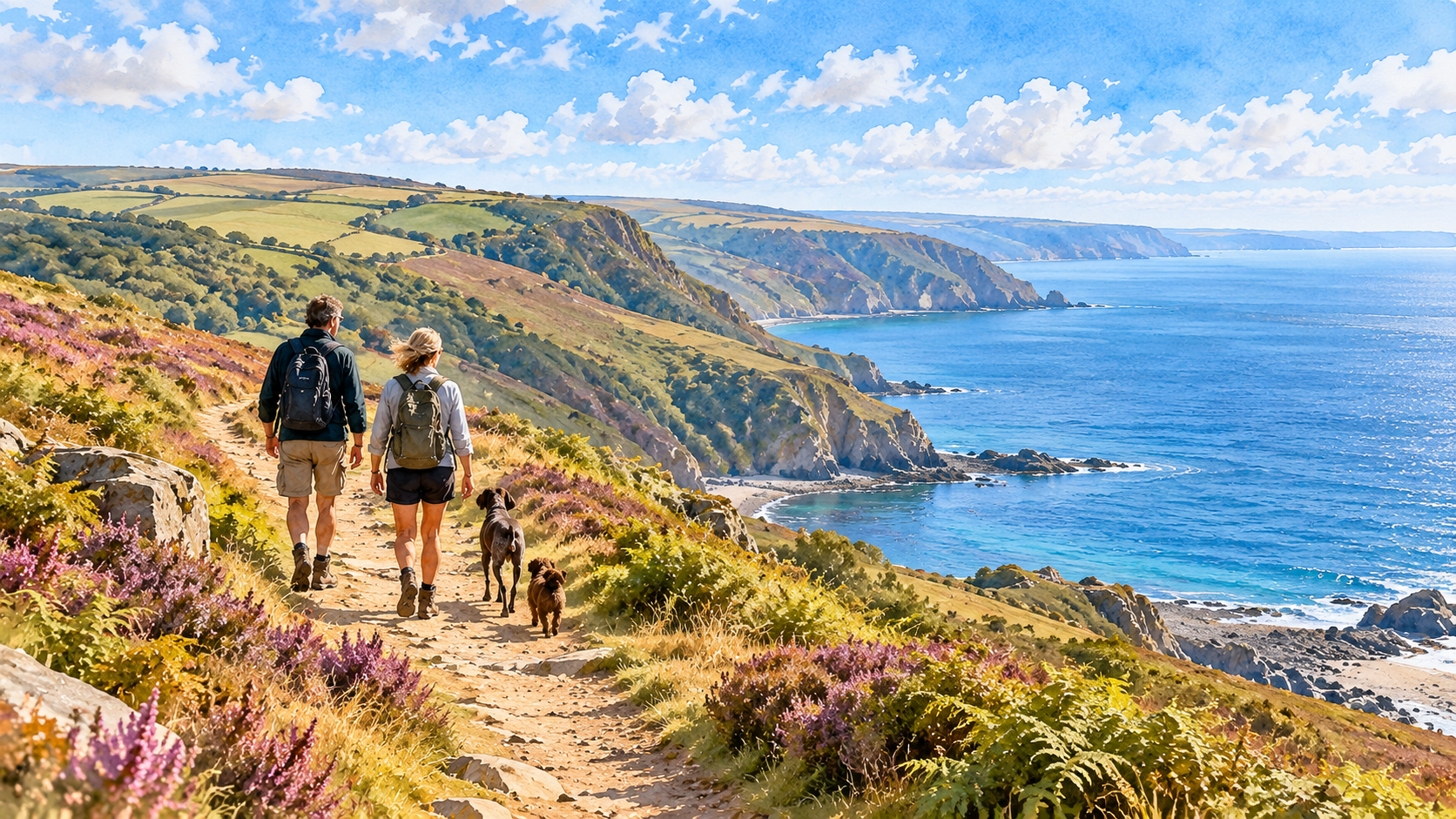
From ancient woodland and riverside paths to open moorland and dramatic coastal valleys, walking is one of the best ways to discover Exmoor.
There are many ways to explore Exmoor, but we think walking is one of the best.
Leave the car behind and the landscape changes. You start noticing the sound of the river, the smell of the woodland, ponies grazing on the moor and views you would simply drive past.
And you certainly don't need to be an experienced hiker.
Exmoor National Park has everything from short accessible strolls to two-hour woodland walks and serious all-day hikes. Its official walking collection includes Exmoor Strolls, Exmoor Explorers and longer Exmoor Classics, so there's something for almost every ability. Exmoor National Park
Here are some of the walks we'd put on your list when staying at Luckett Farm.
1. Tarr Steps & the River Barle
Best for: Woodland · River · History
Allow: Around 1–2 hours
Difficulty: Easy to moderate
Luckett Farm rating: Don't miss it
Tarr Steps is one of the classic Exmoor walks, and for good reason.
The famous clapper bridge crosses the River Barle beneath a canopy of woodland. At 54 metres long and with 17 spans, it's the longest surviving clapper bridge of its kind in Britain. Exmoor National Park
But the bridge isn't really the walk.
The magic is following the River Barle through the surrounding woodland and meadows.
The usual Exmoor Explorer circuit is around 3.5 km / 2 miles and takes a little over an hour. However, there's an important current caveat: the bridge at Hinds Pitt upstream has been closed since May 2025, meaning the normal circular route cannot presently be completed. You can still walk upstream from Tarr Steps, but need to return on the same side. Exmoor National Park
Luckett Farm says
This would be high on our list for somebody visiting Exmoor for the first time.
Don't rush the bridge. Walk beside the river, enjoy the woodland and give yourself time for a drink or something to eat afterwards.
Good to know: Check the latest National Park route information before setting out because river conditions and path closures can change.
2. Dunkery Beacon
Best for: Big views · Moorland · First-time visitors
Distance: Around 2.5 miles / 3.9 km for the Explorer circuit
Time: Around 1 hour 10 minutes
Difficulty: Moderate
If you want to stand on top of Exmoor, this is the one.
At 502 metres, Dunkery Beacon is the highest point on Exmoor. The shorter official Explorer route climbs steadily from the car park to the summit before returning on a steeper descent. Exmoor National Park
On a clear day, the views are enormous.
It's a wonderful introduction to the openness of the moor and there's also a chance of seeing red deer.
For people wanting something gentler, there's a shorter 1.5-mile Exmoor Stroll following a stony track towards the summit. Exmoor National Park
And serious walkers can make considerably more of it: the Exford and Dunkery Beacon Classic is about 11 miles / 18 km and takes around four to five hours. Exmoor National Park
Luckett Farm says
Pick your day.
Dunkery on a clear morning and Dunkery disappearing into cloud are two completely different experiences.
For the views, we'd save this for decent weather.
3. Heddon's Mouth
Best for: River · Woodland · Coast
Distance: Around 2¼ miles / 3.6 km
Time: Just over an hour
Difficulty: Relatively gentle
This is a beautiful example of what makes Exmoor unusual.
You start inland and follow the little River Heddon through a steep, wooded valley until suddenly the landscape opens and you reach the sea between some of England's highest cliffs.
The official Explorer route is around 3.6 km, generally following fairly level ground through the valley, although the optional descent to the beach is rougher. Exmoor National Park
There's also a pub close to the start.
Which never hurts.
Luckett Farm says
One of our favourites for visitors who want a proper sense of adventure without committing to a long hike.
You get woodland, river, cliffs and sea in little more than an hour.
That's quite a return on your investment.
4. Horner Woods
Best for: Ancient woodland · Wildlife · Autumn
Distance: Around 3.5 miles / 5.4 km
Time: Around 2 hours
Difficulty: Moderate
If your mental image of Exmoor is entirely open moorland, Horner Woods will change it.
This is a beautiful woodland walk following Horner Water, initially along the valley before climbing to a viewpoint over the wooded landscape.
The official Explorer route is about 5.4 km / 3.5 miles and takes around two hours. The second half involves a substantial climb, so don't be fooled by the gentle beginning. Exmoor National Park
There's also a shorter accessible option along the lower valley for those who don't want the climb. Exmoor National Park
Luckett Farm says
This is exactly the kind of place we'd choose in autumn.
Trees turning colour, water running through the valley and that slightly damp, earthy smell you only get in old woodland.
Take proper footwear.
5. Lynmouth to Watersmeet
Best for: Rivers · Woodland · Waterfalls · Lunch
Difficulty: Moderate
Start in Lynmouth and follow the East Lyn River upstream towards Watersmeet.
This is Exmoor at its greenest.
Rather than wide-open moorland, you're walking through a steep wooded valley with the river constantly beside you.
The National Park includes Lynmouth and Watersmeet among its ten selected shorter Explorer walks, describing the route as following the East Lyn upstream to its meeting with Hoar Oak Water. Exmoor National Park
The wider Watersmeet landscape also has more challenging routes through sessile oak woodland, with wildlife that can include deer and, for very fortunate walkers, otters. National Trust
Luckett Farm says
A particularly good choice when you want to combine walking with exploring Lynmouth.
Walk first.
Lunch afterwards.
You'll enjoy both more.
6. Valley of Rocks
Best for: Dramatic scenery · Coast · Photography
Difficulty: Choose your route
The Valley of Rocks near Lynton doesn't feel quite like anywhere else on Exmoor.
Huge rock formations rise above the coast, with views towards the Bristol Channel and the famous feral goats roaming around the valley.
There are various ways of exploring the area on foot, so we'd treat this less as a single prescribed walk and more as somewhere to wander.
Combine it with Lynton and Lynmouth and you've got one of North Devon's best days out.
Luckett Farm says
Go early if you can.
Walk the valley before spending some time in Lynton or Lynmouth.
And take your camera.
7. Porlock Marsh
Best for: Easy coastal scenery · Wildlife · Big skies
Difficulty: Relatively gentle
For something quite different again, try Porlock Marsh.
The official Exmoor Explorer route starts from Porlock and follows a boardwalk through the marsh, with open views towards the sea. Exmoor National Park
It's flatter and more open than many of the wooded Exmoor walks, creating an almost haunting landscape.
This is a particularly good option if you want coastal atmosphere without tackling one of Exmoor's steeper cliff walks.
Luckett Farm says
Combine the walk with Porlock and Porlock Weir.
This is the sort of day where we'd deliberately avoid making too many plans.
Walk. Explore. Find lunch. See where you end up.
8. Simonsbath & Wheal Eliza
Best for: River valleys · History · Quieter Exmoor
Difficulty: Moderate
If you'd like to experience a quieter side of Exmoor, head towards Simonsbath.
The Explorer route follows the upper valley of the River Barle towards the remains of Wheal Eliza. Exmoor National Park
It feels more remote than some of the better-known visitor locations and combines beautiful countryside with a little of Exmoor's industrial history.
Luckett Farm says
A good one when you've already visited Tarr Steps and Dunkery and want to discover somewhere less obvious.
9. Doone Valley
Best for: Literature · Moorland · River valley · History
Difficulty: Moderate
The Doone Valley is closely associated with R.D. Blackmore's Lorna Doone, but you certainly don't need to have read the novel to enjoy walking here.
The National Park's Explorer route follows Badgworthy Water through fields and woodland before reaching open moorland and the site of a deserted medieval village. Exmoor National Park
It's another example of how quickly the Exmoor landscape changes when you're walking through it.
Luckett Farm says
One for guests who want something that feels a little more remote and distinctly Exmoor.
Take your time.
10. Exford to Dunkery Beacon
Best for: A proper day's walk
Distance: Around 11 miles / 18 km
Time: Around 4–5 hours
Difficulty: Challenging
If the shorter walks sound suspiciously easy, this one's for you.
Starting in Exford, this circular route climbs through farmland and moorland to Dunkery Beacon before eventually returning.
At around 18 km / 11 miles, it's one of Exmoor National Park's Classic walks. Exmoor National Park
This isn't something we'd recommend setting off on casually after a large Sunday lunch.
Come prepared.
Check the weather.
Take water and food.
Wear appropriate footwear.
And allow plenty of daylight.
Luckett Farm says
If you enjoy walking, dedicate a day to it.
Then come back to Luckett Farm, open something cold and feel extremely pleased with yourself.
Which Exmoor walk should I choose?
If you're staying at Luckett Farm and aren't sure where to start, we'd keep it simple.
| If you want… | We'd choose… |
|---|---|
| Your first Exmoor walk | Tarr Steps |
| The best big views | Dunkery Beacon |
| Woodland | Horner Woods |
| River and woodland | Lynmouth to Watersmeet |
| River meeting the sea | Heddon's Mouth |
| Dramatic coastal scenery | Valley of Rocks |
| Something gentler | Porlock Marsh |
| Quieter Exmoor | Simonsbath & Wheal Eliza |
| History and atmosphere | Doone Valley |
| A serious day's walk | Exford to Dunkery Beacon |
Walking Exmoor with a dog
Exmoor can be wonderful walking country for dogs, but remember you're in working countryside.
You may encounter sheep, cattle, horses and ponies, as well as wildlife.
Dogs should be kept under close control and you'll need to follow any signs or temporary restrictions you encounter.
It's also worth checking the individual route before setting out rather than assuming every walk is suitable in every season.
We'll cover this properly in our forthcoming Dog-Friendly North Devon & Exmoor Guide.
What should I take walking on Exmoor?
Even on a relatively short walk, we'd recommend sensible footwear, water and an extra layer.
Exmoor weather can change quickly.
For longer walks, take a proper map or reliable navigation, waterproof clothing, food and enough water.
And don't rely entirely on your phone.
The more remote the walk, the more prepared you should be.
What are the best easy walks on Exmoor?
If you want something relatively gentle, look at the National Park's Exmoor Strolls collection.
These are short, step-and-stile-free routes designed to make some of Exmoor's best landscapes accessible to more people. Locations include Dunkery Beacon, Horner Woods, Bossington Hill and Countisbury Common. Exmoor National Park
The separate Exmoor Explorers collection is the next step up: ten selected shorter routes, generally taking from under an hour to around two and a half hours. Exmoor National Park
That's a useful way of choosing a walk according to how energetic you're feeling that morning.
What's the best walk on Exmoor for first-time visitors?
We'd probably choose between Tarr Steps and Dunkery Beacon.
Choose Tarr Steps if you prefer rivers and woodland.
Choose Dunkery if you want open moorland and far-reaching views.
If you've got two days?
Do both.
They show you two completely different sides of Exmoor.
What's the best woodland walk?
Horner Woods would be very high on our list.
For a combination of woodland and river scenery, we'd also look at Lynmouth to Watersmeet and Heddon's Mouth.
What's the best coastal walk on Exmoor?
For a relatively short experience, Heddon's Mouth is hard to beat.
For more dramatic open scenery, explore around the Valley of Rocks.
And experienced walkers have plenty of longer options along the Exmoor section of the South West Coast Path.
When is the best time to walk on Exmoor?
Every season gives you something different.
Spring brings new growth and longer days.
Summer gives you maximum daylight for longer routes.
Autumn transforms the wooded valleys.
Winter can be wonderfully atmospheric, although shorter daylight and more difficult weather mean you need to plan more carefully.
Our favourite?
That depends on the walk.
For Horner Woods, we'd love autumn.
For Dunkery Beacon, give us a crisp, clear morning.
For Heddon's Mouth, a beautiful late spring day.
And for Tarr Steps?
Pretty much anytime.
A final piece of advice
Don't turn walking on Exmoor into a competition.
You don't have to climb the highest point.
You don't have to walk 15 miles.
And you certainly don't need to complete every route on this page.
Sometimes the best walk is simply the one that suits the weather, your mood and how long you want to spend in the pub afterwards.
Pick one.
Put your boots on.
And go and see where it takes you.
Back to Luckett Farm
One of the pleasures of a proper countryside walk is coming home afterwards.
Back at Luckett Farm, boots can come off.
The fire can go on.
Dinner can wait.
And if your property has a hot tub, aching legs have a fairly obvious next destination.
Tomorrow?
You could walk somewhere else.
Or you could head to the beach.
That's the beauty of staying in North Devon.